What is fantasy cricket?
Fantasy cricket is a way to follow a real match through a team of players you select. Their match performances are converted into points under the rules of the particular fantasy format. Your team’s total depends on those points and any captain multipliers, rather than simply on which real team wins.
Start by separating three decisions: which fixture you are following, which players you can select, and which scoring rules apply. A prediction about the match winner is a different activity from building a fantasy player team. This guide covers the player-team format.
You can practise the process with a paper team and a scorecard. You do not need to download an app or enter a paid contest to understand the examples below.
Before selecting a player, read these five rules
- Match and format. Check the teams, competition, start time and whether the rules are for T20, ODI, Test or another format. Do not use yesterday’s fixture because the team names look familiar.
- Team size and roles. Read the required player count and the allowed numbers of wicketkeepers, batters, all-rounders and bowlers. Use the role assigned by the platform, even when a player also contributes in another way.
- Credit budget. Each selection has a cost. Add the costs of all selected players and stay within the cap. A player’s credit price is not a promise of their match points.
- Limits and multipliers. Check the maximum players from one real team and how captain and vice-captain scores are calculated.
- Lock time and participation. Check when changes close, which announced lineups are available, and how substitutes, replacements or abandoned matches are handled.
These settings are not universal. For example, Dream11’s own rules separate several cricket formats and include a distinct five-player second-innings format. An eleven-player example should therefore never be treated as the rule for every fantasy contest. Read the platform’s format-specific rules ↗
A worked example: 11 players, 92.5 credits
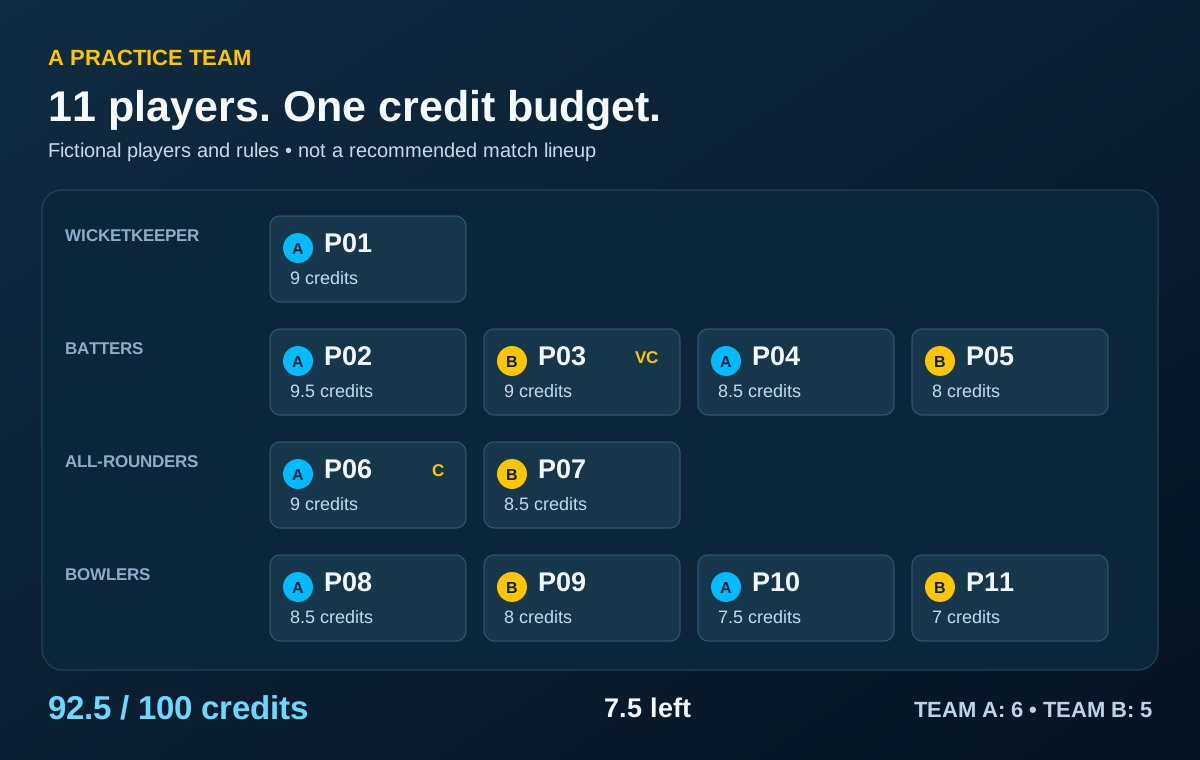
Imagine a practice match between fictional Team A and Team B. For this example only, the selection rules are: exactly 11 players, at most 100 credits, at most seven players from either side, and role limits of 1–4 wicketkeepers, 3–6 batters, 1–4 all-rounders and 3–6 bowlers.
| Player | Side | Role | Credits | Choice |
|---|---|---|---|---|
| P01 | A | Wicketkeeper | 9 | — |
| P02 | A | Batter | 9.5 | — |
| P03 | B | Batter | 9 | Vice-captain |
| P04 | A | Batter | 8.5 | — |
| P05 | B | Batter | 8 | — |
| P06 | A | All-rounder | 9 | Captain |
| P07 | B | All-rounder | 8.5 | — |
| P08 | A | Bowler | 8.5 | — |
| P09 | B | Bowler | 8 | — |
| P10 | A | Bowler | 7.5 | — |
| P11 | B | Bowler | 7 | — |
| 11 players · A: 6 / B: 5 | 92.5 | 7.5 left | ||
The role subtotals are 9 + 35 + 17.5 + 31 = 92.5 credits. Every role count is inside this exercise’s limits, and neither side exceeds seven players. Leaving 7.5 credits unused is valid here; spending the entire budget is not a separate requirement.
Valid selection
The table has 11 players and costs 92.5 credits. It passes all the stated checks.
Invalid selection
Replace P11’s seven-credit bowler with a fictional 16-credit bowler: 92.5 − 7 + 16 = 101.5. Even with 11 players and valid roles, that team exceeds the budget by 1.5 credits.
A team with 12 players also fails this exercise, even if it costs less than 100. Check each rule independently rather than using a low total cost as proof that the whole selection is valid.
How to think about player roles
Look for a clear explanation of how a player might contribute. Batting position affects the opportunity to face deliveries. Bowling role affects when a player may bowl. A wicketkeeper can have both batting and keeping contributions. An all-rounder may contribute in both innings, but the label alone does not guarantee either opportunity.
Write down the reason for each selection before looking at the final team. For example: “expected to bat near the top” is a checkable assumption; “this name always scores well” is not. Recheck the assumption against current team information. A familiar player who is not taking part cannot be treated like a confirmed starter.
Past statistics can describe what happened, but they do not guarantee the next match. A balanced-looking role layout is a valid structure, not evidence that it will produce the highest score.
Captain and vice-captain change the points
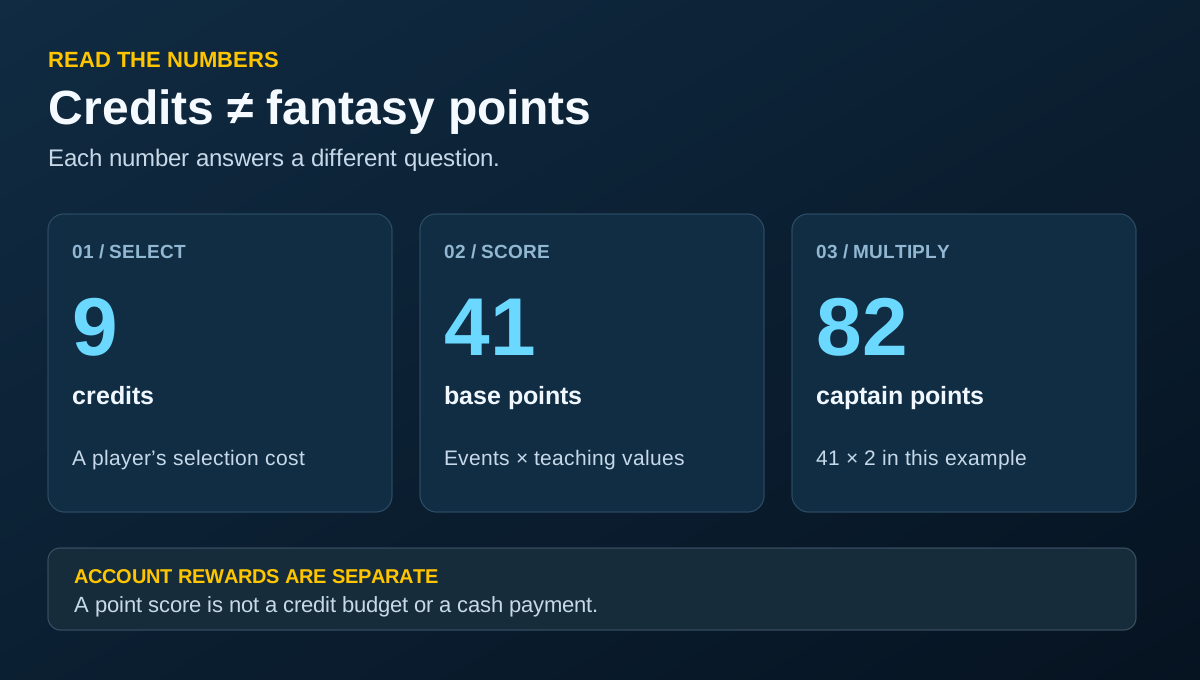
In a teaching example with a 2× captain multiplier and a 1.5× vice-captain multiplier, a player earning 40 base points contributes 80 as captain or 60 as vice-captain. They would contribute 40 without either role. Those are alternative roles for the same score, not three amounts to add together.
Apply the multiplier to the eligible point total defined by the chosen format. Do not multiply the player’s credit cost. Confirm that your captain and vice-captain are different selected players where the platform requires that. Our points-versus-credits guide works through batting, bowling and multiplier arithmetic step by step.
Probable XI, confirmed XI and the deadline
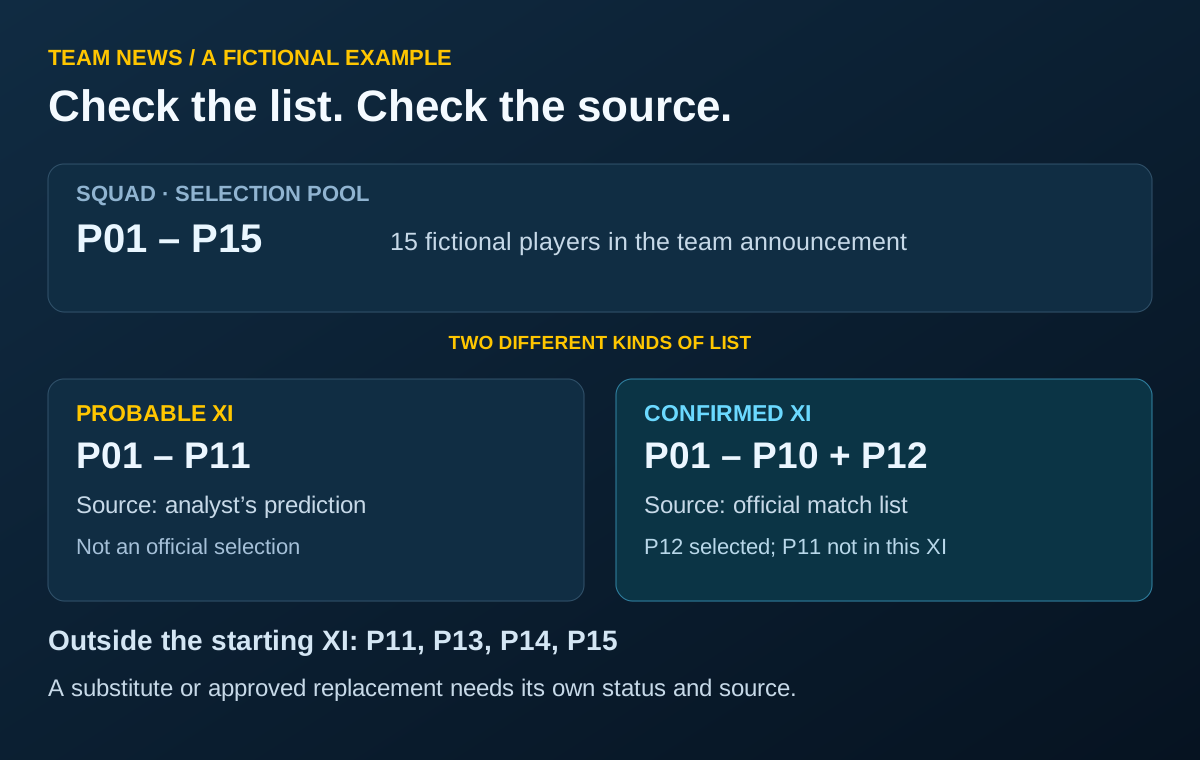
Use our squad, playing XI and substitutes guide for a source-labelled list example.
A probable XI is a forecast of who might play. A confirmed lineup is an announced selection. Treat them differently: an early preview can help you prepare, but it is not a replacement for the match’s announced team information.
Before the actual lock time, compare your saved team with the latest available lineup and review the platform’s substitute rules. Do not assume that a named substitute will earn points or that changes will stay open until the first ball. When the lineup is unavailable before lock, that uncertainty remains; a forecast does not become confirmed because the deadline is close.
For a repeatable match-day routine, use the IPL team-selection checklist. Its preparation steps complement this guide; the current fixture and contest rules still control the final decisions.
Where the concepts appear in COME
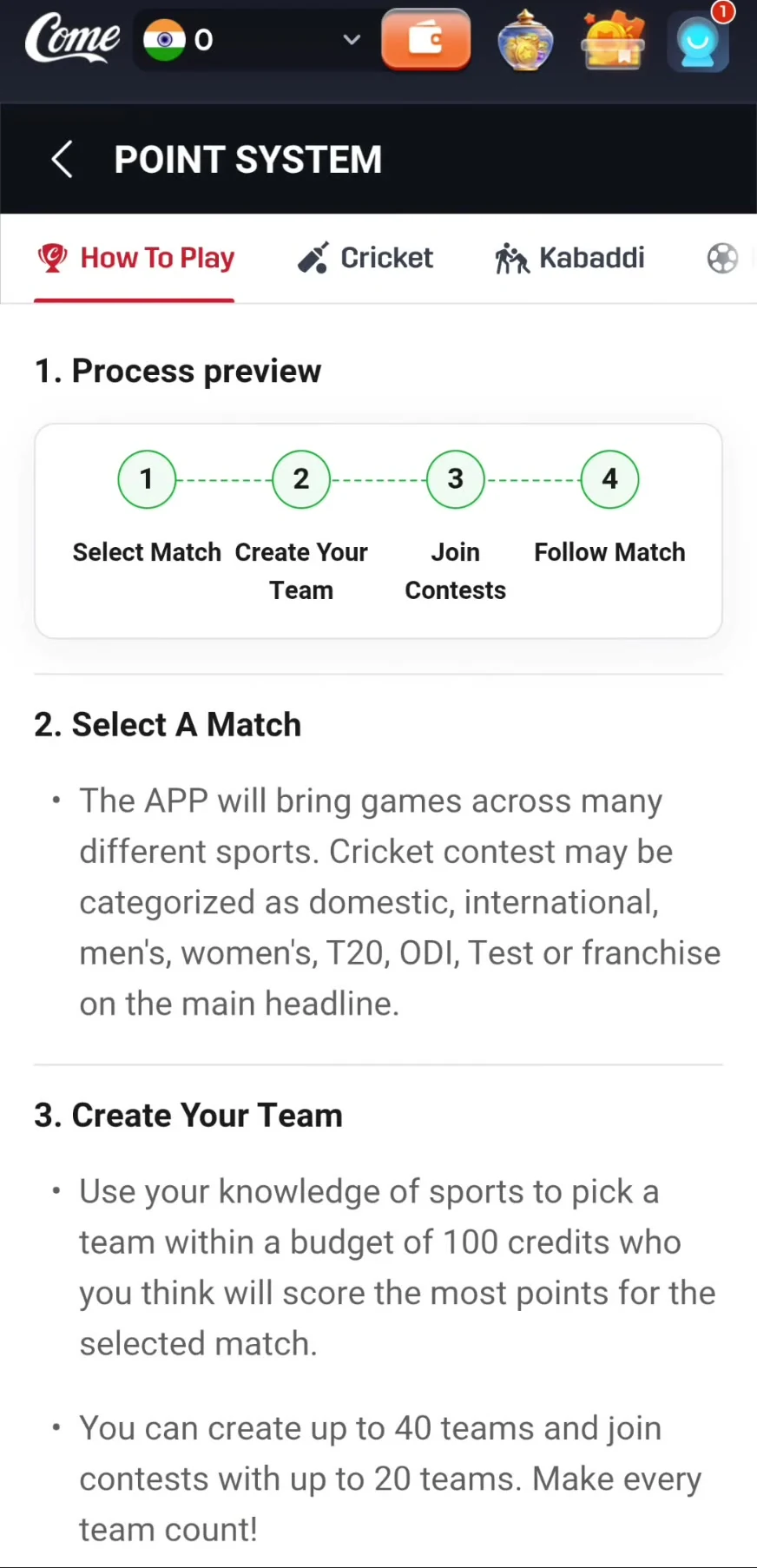
This archived screen shows how a platform can present match selection, team creation and match following as separate steps. It provides interface context for the ideas above.
The screenshot also contains dated budget and entry-limit instructions. Check the rules currently shown in the app before using those values. For the recorded interface walkthrough, continue to how COME Fantasy works.
The fictional team in this article is independent of that screenshot. No claim is made that its exact combination is accepted by every current COME format.
After the match: read the point breakdown
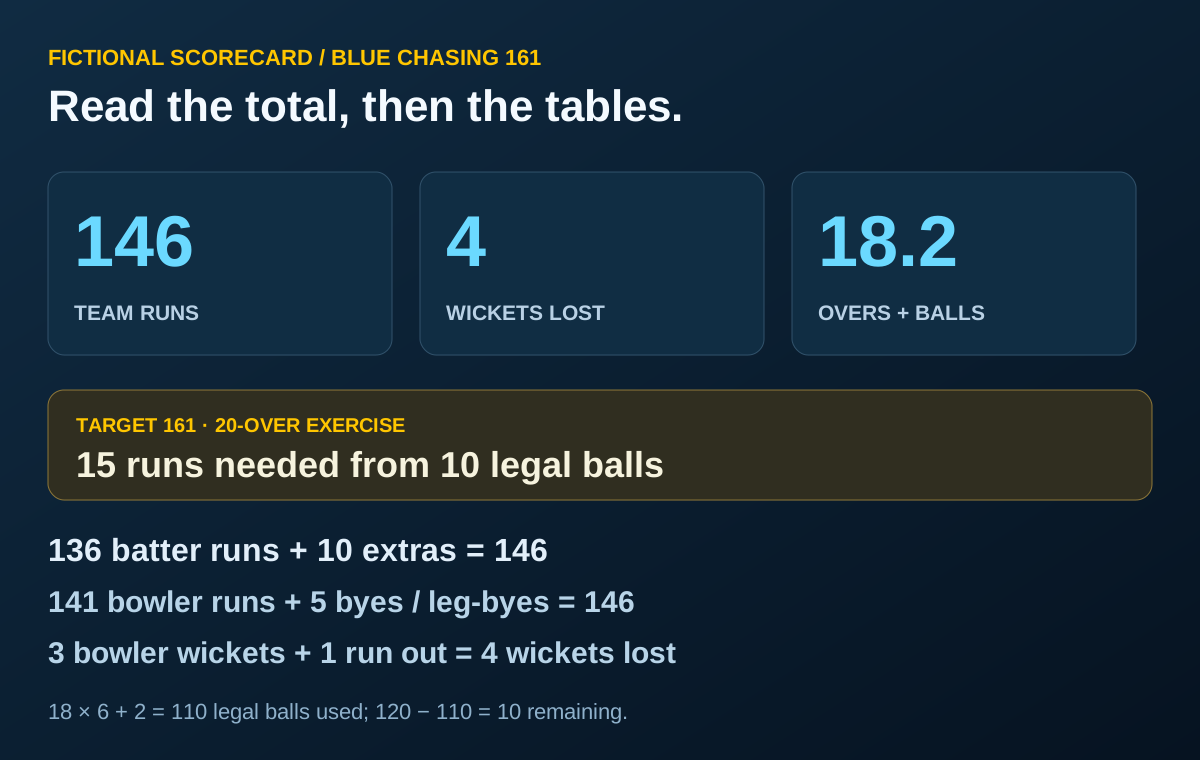
Match each selected player to their batting, bowling and fielding events. Use the applicable rules to calculate the base points, then apply the eligible multiplier. Live totals can be provisional, so compare like-for-like stages rather than treating an in-progress figure as a final result.
Keep credits, fantasy points and account balances separate. A 92.5-credit team does not start with 92.5 points; 80 fantasy points do not by themselves represent a cash payment. The platform’s result and account records answer different questions.
Beginner questions
Must I use all 100 credits?
No, not in this example: 100 is a maximum. Follow the actual contest’s budget and selection rules.
Is the most expensive player always the best captain?
A credit price is a selection cost. Captain points depend on the player’s eligible match performance and the scoring rules, so price alone cannot establish the best choice.
Does saving a team mean I have an accepted entry?
Not necessarily. Team creation and entry confirmation can be separate steps. Check the relevant record rather than assuming that a saved lineup was entered.
About this guide. Written by the comeplaygo.com Editorial Team. Examples and diagrams are original teaching materials; figures are not match predictions. Reviewed 2 November 2026.
Platform reference: Dream11’s format-specific rules, checked 2 November 2026. COME interface images are reused from the site’s supplied brand-material archive and dated in their captions.