One scorecard, read in the right order
Start with the team total and match situation, then read the batting and bowling tables. The same letter can mean something different in each table: a batter’s R is runs scored; a bowler’s R is runs conceded.
Read 146/4 and 18.2 separately
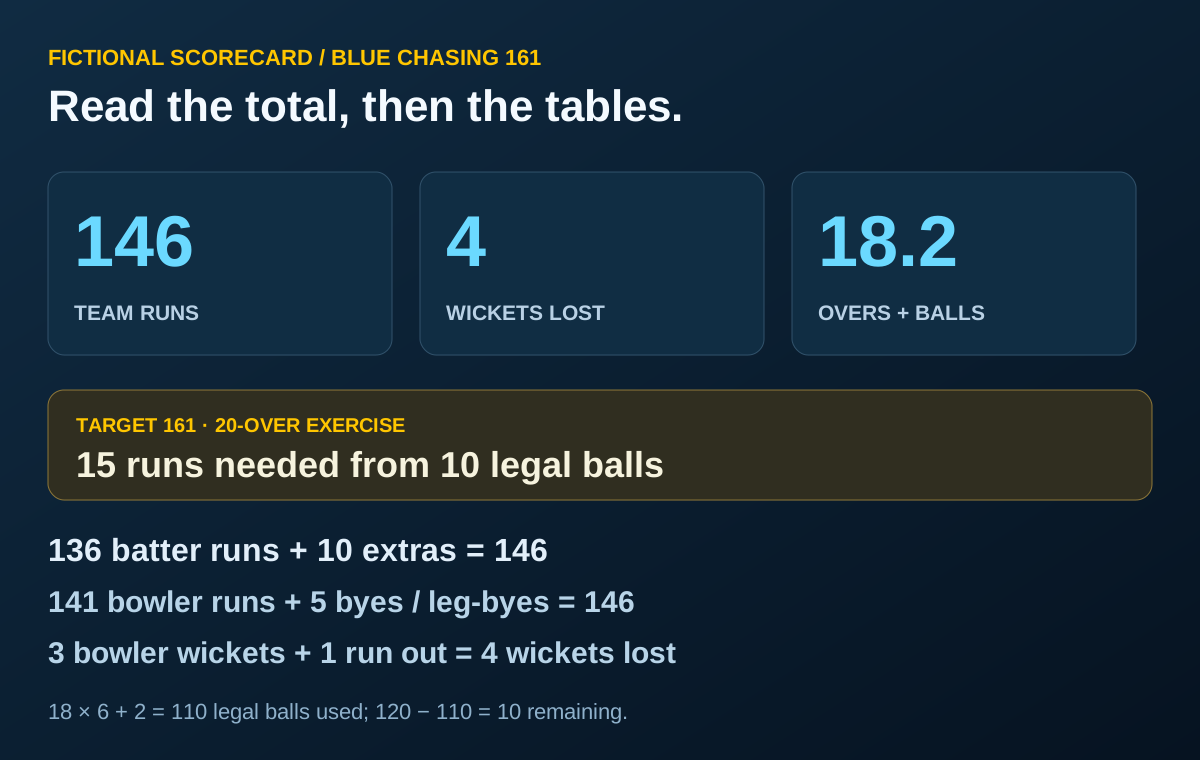
On this card, 146/4 means 146 team runs with four wickets lost. The slash separates runs and wickets; it is not division. Some displays use a dash or reverse the order, so read their labels.
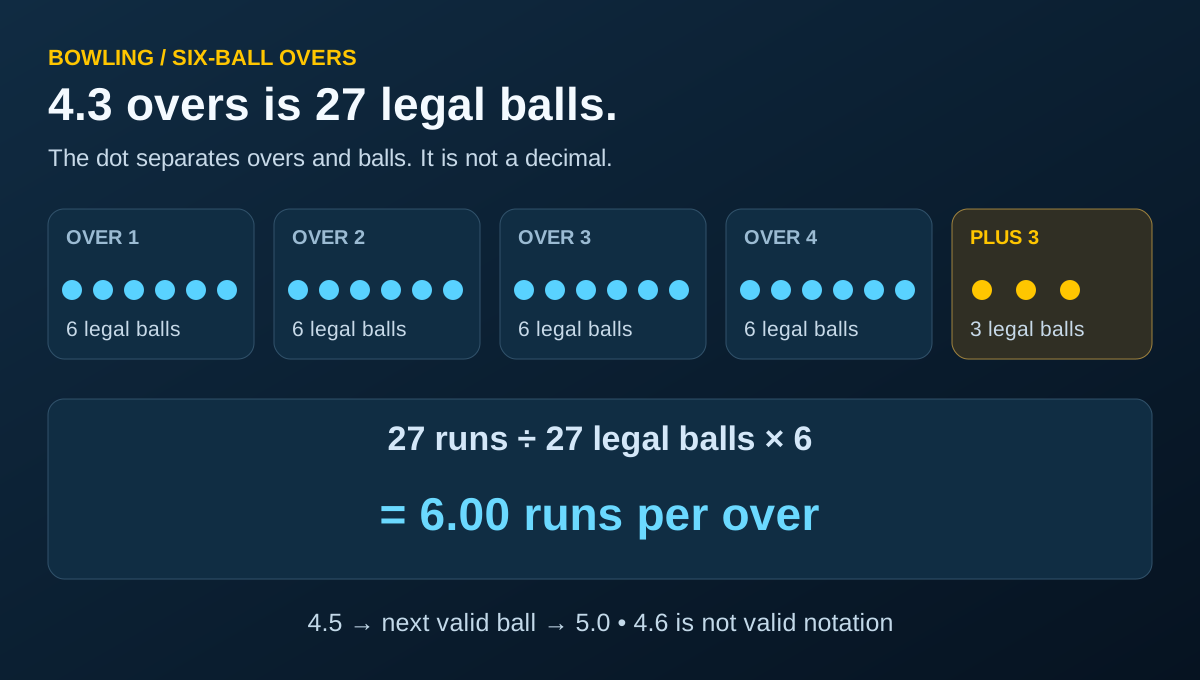
18.2 overs means eighteen completed six-ball overs plus two valid balls: 18 × 6 + 2 = 110. In our 20-over exercise, 120 − 110 = 10 legal balls remain. It does not mean 18.2 decimal overs.
Blue needs 161 − 146 = 15 runs to win. At this snapshot the required rate is 15 ÷ 10 × 6 = 9.00 runs per over. That is the pace needed from the remaining balls, not a probability of winning. Our exercise has no revised target; in an interrupted real match, use the officially announced target and remaining allocation.
Batting: runs, balls, boundaries and strike rate
Read R as runs, B or BF as balls faced, 4s and 6s as boundary counts, and SR as batting strike rate. The dismissal column identifies who is out and how. In this example, “not out” is written explicitly.
| Batter | Dismissal / status | R | B | 4s | 6s | SR |
|---|---|---|---|---|---|---|
| A1 | c B6 b B1 | 42 | 30 | 4 | 1 | 140.00 |
| A2 | b B2 | 28 | 22 | 3 | 0 | 127.27 |
| A3 | lbw b B3 | 36 | 26 | 3 | 1 | 138.46 |
| A4 | run out (B7) | 10 | 12 | 1 | 0 | 83.33 |
| A5 | not out | 14 | 14 | 1 | 0 | 100.00 |
| A6 | not out | 6 | 6 | 1 | 0 | 100.00 |
| Batter totals | 136 | 110 | 13 | 2 | — | |
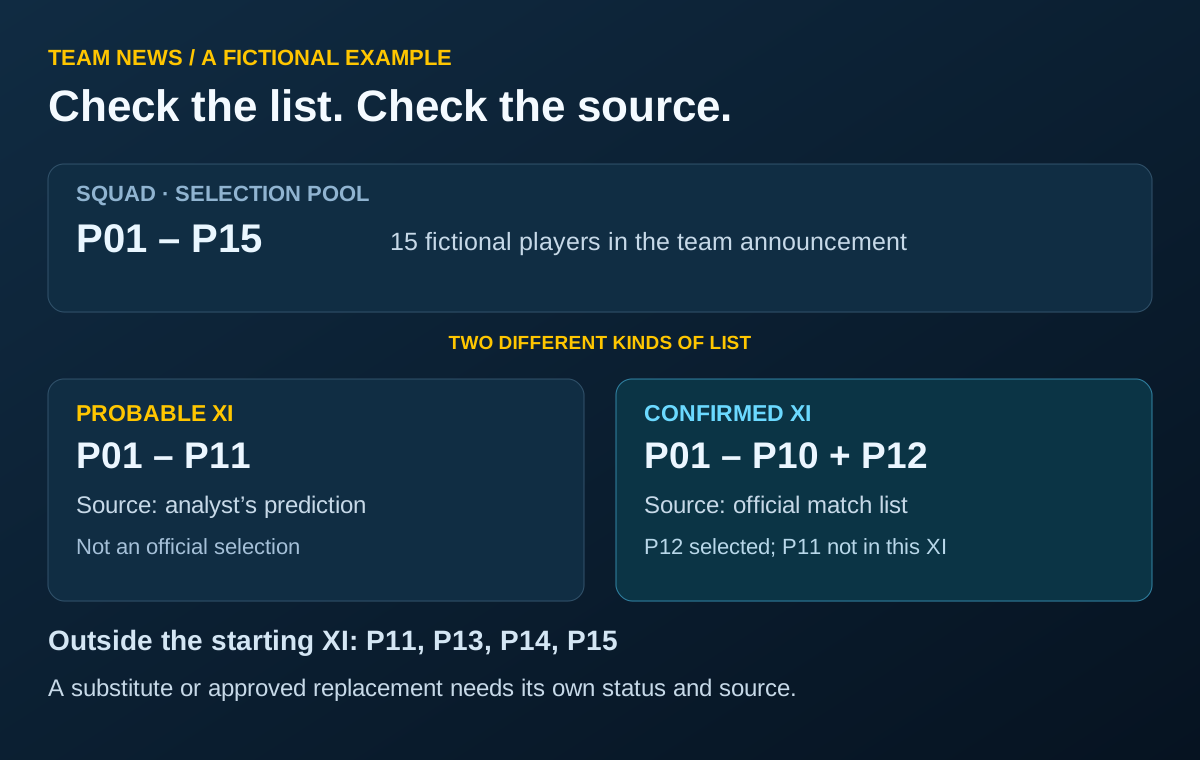
Yet to bat: A7, A8, A9, A10 and A11. A “did not bat” entry is not the same as a completed innings of zero. For the distinction between a team list and participating players, see playing XI and squad status.
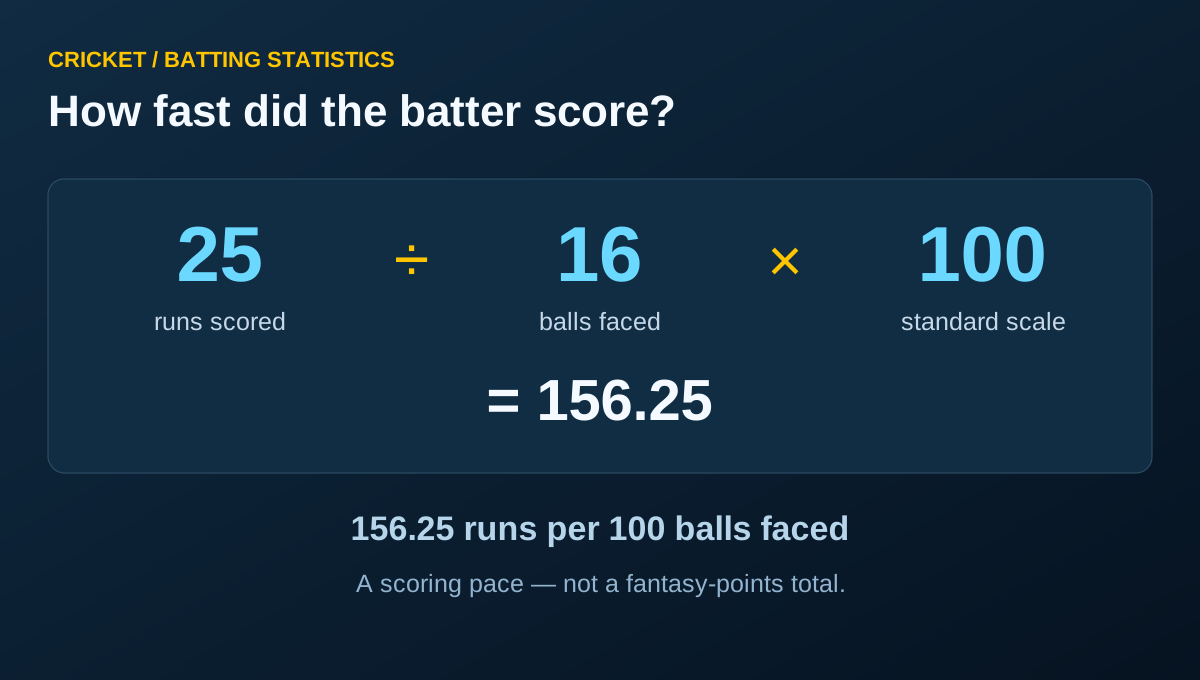
A1’s four fours and one six contribute 4 × 4 + 1 × 6 = 22 of the 42 runs. They are already included in R; do not add them again. A1’s SR is 42 ÷ 30 × 100 = 140.00. Try any row in the batting strike-rate calculator.
Extras explain the gap to the team total
Our extras line is 10: b 2, lb 3, wd 5, nb 0, pen 0. These labels mean byes, leg-byes, wides, no-ball extras and penalty runs. Display abbreviations vary; “w” may mean wides in an extras line but W means wickets in a bowling table.
Adding the six batting rows gives 42 + 28 + 36 + 10 + 14 + 6 = 136. The ten extras complete the team total. They do not belong to an individual batter’s R value. This reconciliation is a useful first check if a copied card looks inconsistent.
Bowling: O, M, R, W and ER
O records overs, M maidens, R runs conceded, W wickets credited to the bowler, and ER or Econ economy rate. A maiden is a complete over in which no runs are charged to that bowler. All maiden counts in this exercise are zero.
| Bowler | O | M | R | W | ER |
|---|---|---|---|---|---|
| B1 | 4.0 | 0 | 24 | 1 | 6.00 |
| B2 | 4.0 | 0 | 31 | 1 | 7.75 |
| B3 | 4.0 | 0 | 28 | 1 | 7.00 |
| B4 | 4.0 | 0 | 36 | 0 | 9.00 |
| B5 | 2.2 | 0 | 22 | 0 | 9.43 |
| Totals | 18.2 | 0 | 141 | 3 | — |
B5 has bowled 2 × 6 + 2 = 14 legal balls. Economy is 22 ÷ 14 × 6 = 9.428571… , displayed as 9.43. Enter 22 runs and 2.2 overs in the economy-rate calculator to see the conversion.
The bowling runs total 141: 136 batter runs plus 5 wides. The other 5 team runs are 2 byes and 3 leg-byes, which are not charged to bowlers. Therefore 141 + 5 = 146. Using the team’s 146 to calculate one bowler’s economy would mix two different records.
Four wickets lost, but three bowler wickets
In A1’s row, “c B6 b B1” means caught by B6 off B1’s bowling. “b B2” means bowled by B2, and “lbw b B3” identifies a leg-before-wicket dismissal credited to B3. These account for three bowler wickets.
A4 is run out by B7. A run out counts toward the batting side’s wickets lost but is not credited as a wicket to the bowler. That is why Blue is four down while Gold’s W column adds to three. Do not “correct” the bowling total to four.
Look at the text around symbols. An asterisk beside a score often marks not out, while symbols beside a name can identify a captain or wicketkeeper. The card’s legend and dismissal wording give the needed context.
Read the situation before judging the number
Blue’s current team rate is 146 ÷ 110 × 6 = 7.96 runs per over. Its required rate is 9.00. These describe different intervals: the innings so far and the chase still to come. Neither is a fantasy-points total.
A scorecard records outcomes, but does not by itself explain every tactical choice or forecast the finish. Check the format, target, remaining balls and available batters before comparing two cards. If you are learning fantasy scoring, continue with credits, performance points and captain multipliers.
Three quick checks
How many balls remain after 18.2 of 20 overs?
Ten. The allocation is 120 balls and 110 valid balls have been recorded: 120 − 110 = 10.
Why do the batting rows add to 136, not 146?
The team total includes ten extras: two byes, three leg-byes and five wides.
Why does the bowling W column add to three?
Three dismissals are credited to bowlers. The fourth is A4’s run out, which counts only in the team wickets total here.
About this guide. Written by the comeplaygo.com Editorial Team. Examples and diagrams are original teaching materials; figures are not match predictions. Reviewed 2 November 2026.
Rules checked 2 November 2026: MCC Laws, 2017 Code, 4th edition (2026), Laws 17, 18.10.3 and 38.6. Field layout reference: Japan Cricket Association score sheet. Maiden terminology: JCA-hosted scoring guide (July 2008); its old no-ball allocation table is not used. All numerical examples and diagrams are original.