Four numbers that answer different questions
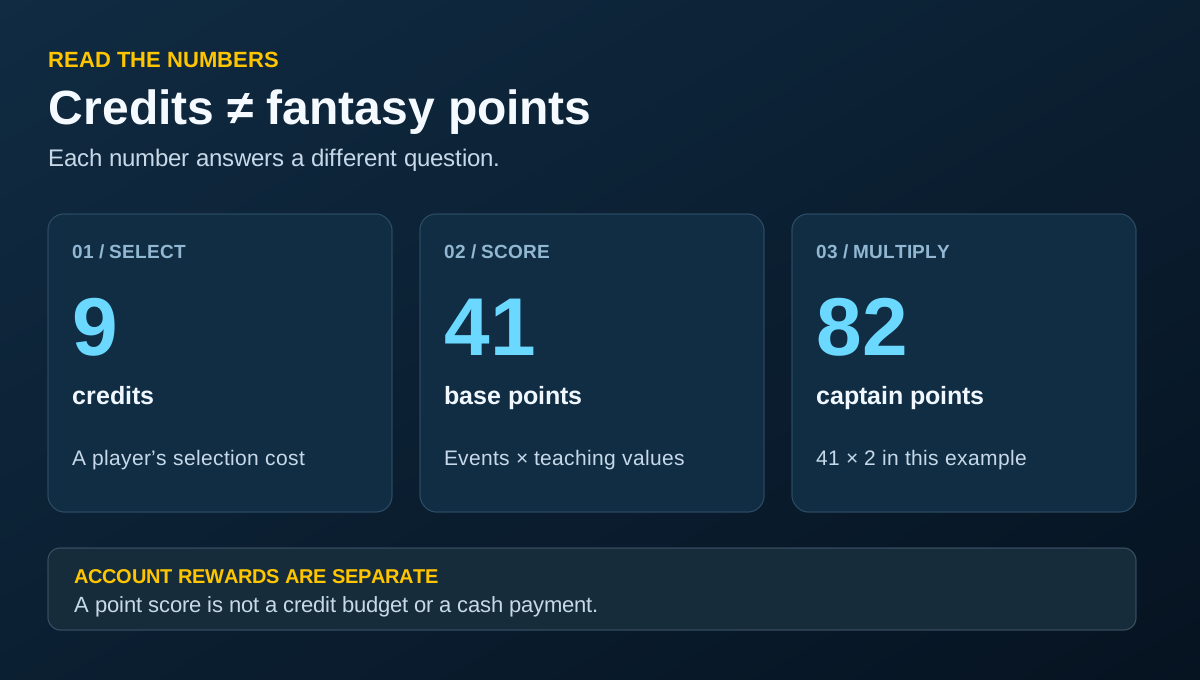
A fantasy screen may show credits, a player score, a captain multiplier and a rewards balance together. They describe different things. Before checking a total, identify which number you are looking at and which stage of the match it belongs to.
| Term | What it means | Do not assume |
|---|---|---|
| Credits | The cost assigned to a player for building a team within a budget. | 9 credits does not mean 9 match points. |
| Base fantasy points | The score from eligible events under the chosen rules, before a captain role multiplier in our examples. | Runs alone may not be the whole score. |
| Captain multiplier | A factor applied to the eligible player score. | 2× does not double the player’s credit price. |
| Rewards or balance | A separate account or contest record with its own conditions. | A fantasy point total is not a cash amount. |
If team selection is still unfamiliar, first use the eleven-player budget example. It shows why a valid team can have credits left over.
The rule sheet for the next two examples
| Event | Teaching points |
|---|---|
| Run scored by the batter | +1 per run |
| Boundary four | +1 additional point per four |
| Boundary six | +2 additional points per six |
| Wicket credited to the bowler, excluding run-out | +20 per wicket |
| Catch | +5 per catch |
| Captain / vice-captain | 2× / 1.5× the complete base score in this model |
For this exercise there are no lineup points, milestone awards, duck deductions, strike-rate adjustments, economy adjustments, wicket-type bonuses or other events. All omitted items are worth zero in this model. Explicitly stating the exclusions prevents a missing rule from silently changing the answer.
Example 1: 30 runs become 41 base points
Our fictional batter scores 30 runs from 20 balls, including four fours and one six, and takes one catch. The remaining eight runs come from running between the wickets. They take no wickets and have no other scoring events.
- Runs: 30 × 1 = 30 points.
- Four bonuses: 4 × 1 = 4 additional points.
- Six bonus: 1 × 2 = 2 additional points.
- Catch: 1 × 5 = 5 points.
- Base total: 30 + 4 + 2 + 5 = 41 points.
The boundary runs are already included in the 30-run score. Add only the stated boundary bonuses; adding 16 runs for the fours and six runs for the six again would count those runs twice. Similarly, 82 is the whole captain contribution here, not 82 extra points on top of 41.
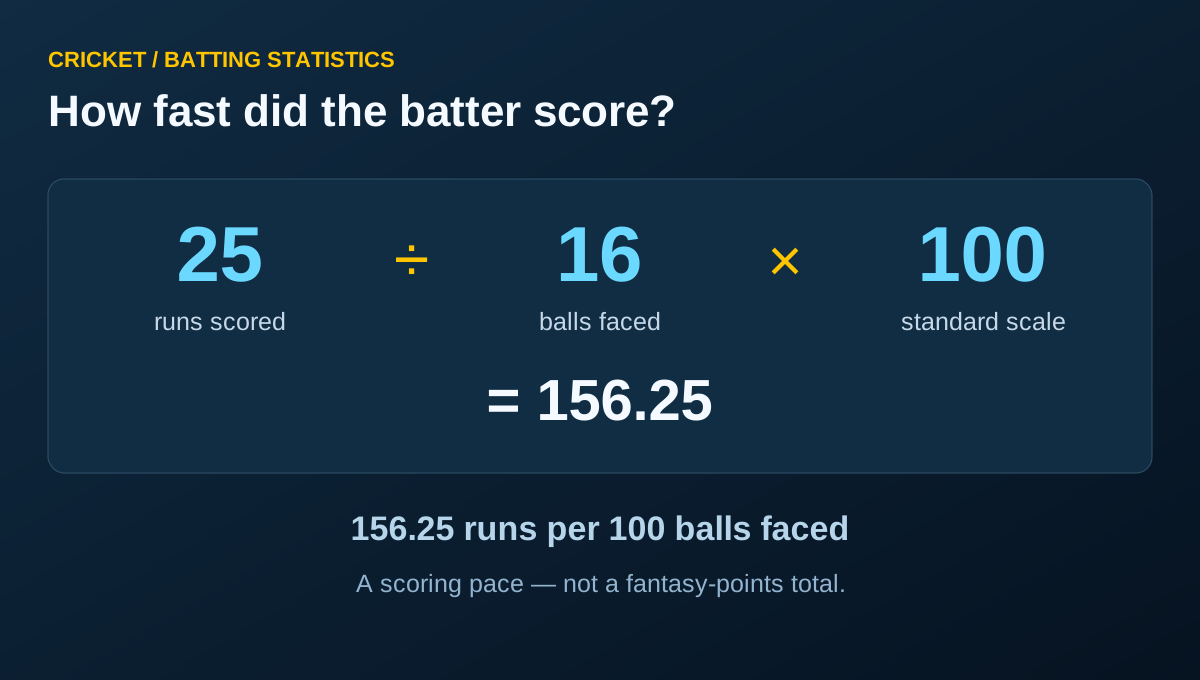
The batting strike rate is (30 ÷ 20) × 100 = 150.00. Our teaching model has no strike-rate bonus, so that statistic adds zero points. A rate can be calculated correctly without producing a scoring adjustment.
Example 2: two wickets and a catch
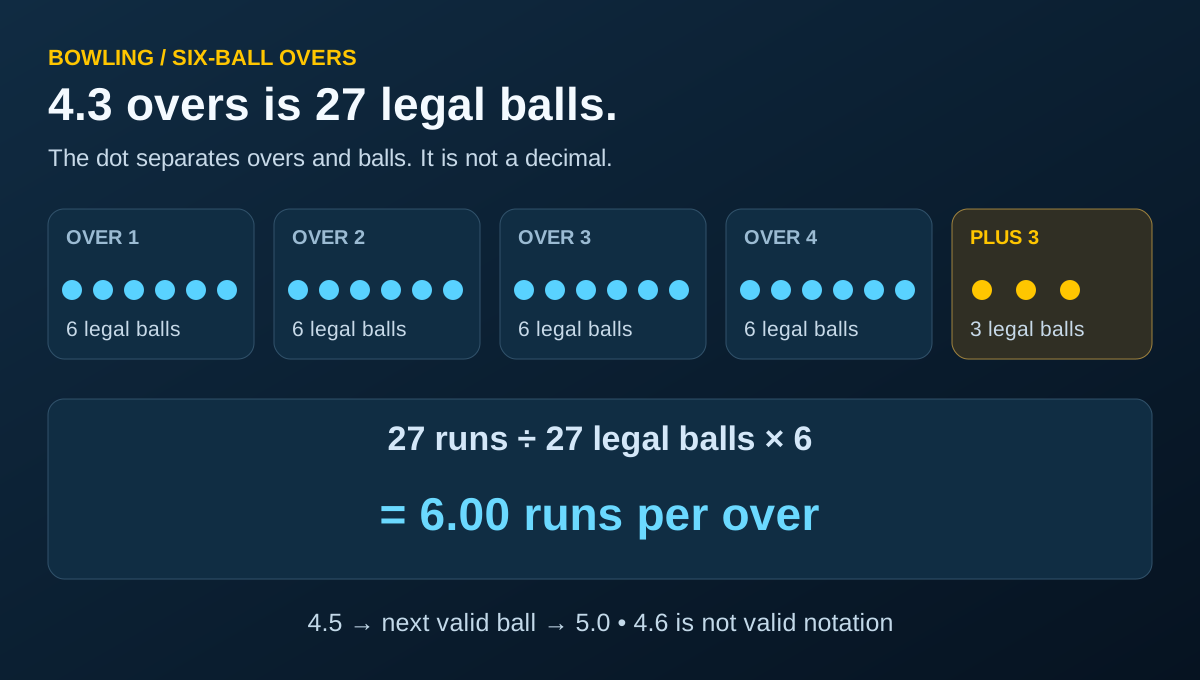
Our fictional bowler finishes with two wickets credited to the bowler, concedes 24 runs in four completed six-ball overs, scores three batting runs without a boundary, and takes one catch. Neither wicket is a run-out, and there are no other scoring events.
- Wickets: 2 × 20 = 40 points.
- Batting runs: 3 × 1 = 3 points.
- Catch: 1 × 5 = 5 points.
- Base total: 40 + 3 + 5 = 48 points.
The economy rate in this completed-over example is 24 ÷ 4 = 6 runs per over. Check it with the economy-rate calculator, which also handles partial overs. Because our model has no economy adjustment, the rate does not change the 48-point base score. In a real platform, first check whether the format awards economy points and whether the player meets the minimum overs requirement.
To combine these two players in a team total, choose one role per player. If the batter is captain and the bowler is vice-captain, their combined contribution is 82 + 72 = 154 points. You would then add each other selected player’s eligible contribution.
Why the actual platform total can differ
A complete scoring system can include more event types than the teaching model. Read the rules for the exact sport, match format and contest variant. Do not transfer a point value from an app, a past season or a different format just because the event has the same name.
- Strike rate and economy: check the eligibility threshold, minimum balls or overs, role exclusions and exact band boundaries.
- Milestones: check whether bonuses stack or whether only the highest reached milestone applies.
- Wickets and fielding: check run-out treatment, dismissal-type bonuses and how shared run-out credit is assigned.
- Participation: check announced-lineup points, substitute eligibility and replacements.
- Corrections: compare live and final totals only after accounting for the match and contest review status.
As a concrete source example, Dream11’s own rules have separate format tabs and specific minimum-participation conditions for rate adjustments. That demonstrates why the full rule sheet matters; it does not make those conditions the rules for COME.
Reading a dated COME scoring screenshot
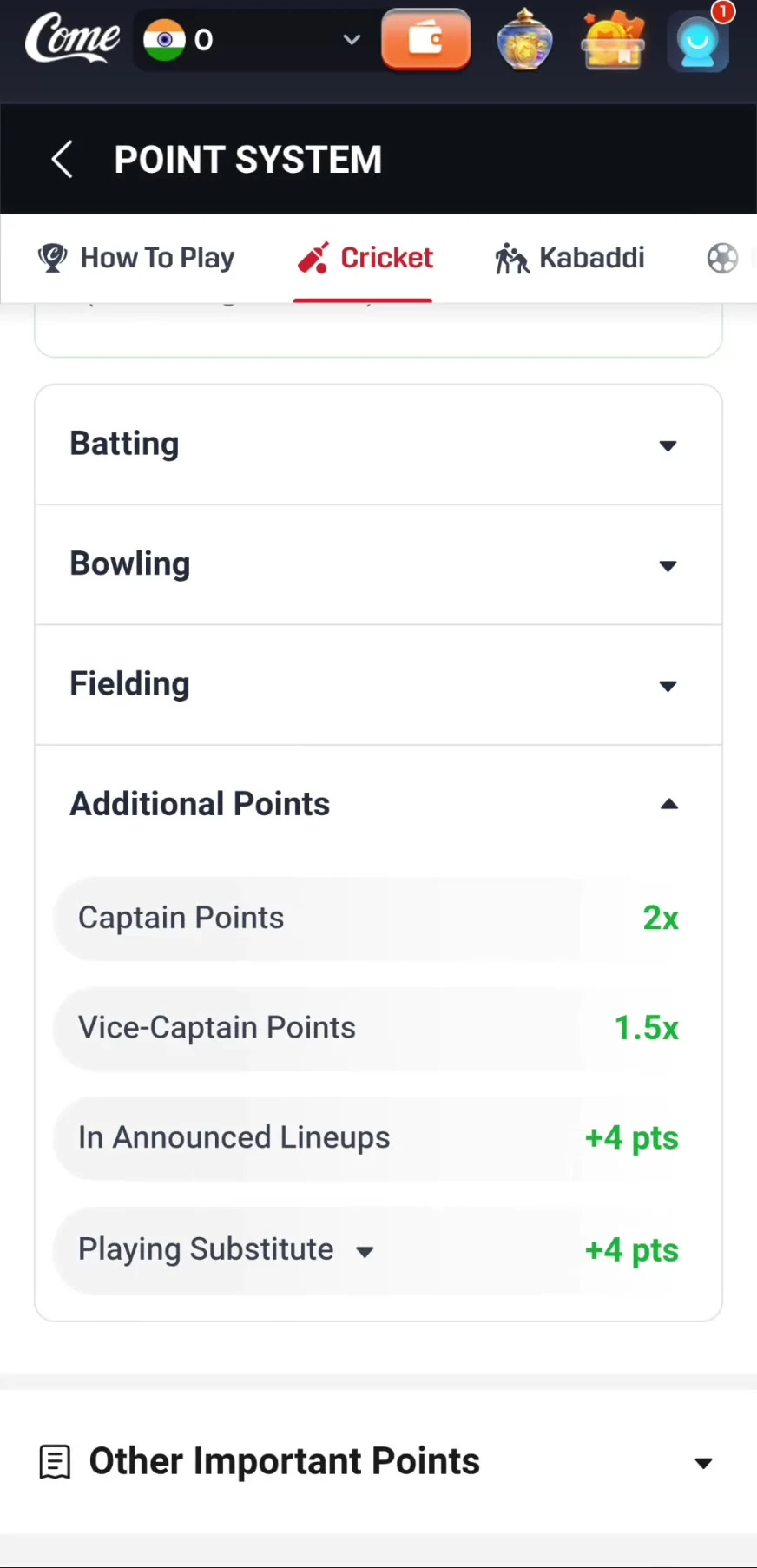
The archived COME screen groups captain choices under Additional Points. It helps distinguish a multiplier from a credit budget.
The existing COME T20 scoring reference documents the recorded rows and an unresolved inconsistency in the source material. Use that guide for dated context, then check the rules displayed for the current format. The illustrative values above were chosen independently of that table.
For the separate account panels, see COME Skill Score, Fantasy Coins and rewards.
A simple way to check a disputed total
- Confirm the player, fixture, format and whether the displayed result is live or final.
- Write down the match events using the corresponding scorecard.
- Apply each eligible rule once, including any deductions.
- Apply the captain or vice-captain treatment specified by that format.
- Compare the breakdown, not only the headline total. Keep the rule version and match reference if you need to ask for clarification.
For a rate check, use the batting strike-rate calculator. It calculates the statistic only; the platform’s rules determine whether that statistic earns fantasy points.
Common scoring questions
Can credits increase when my player scores runs?
Credits in these examples are selection costs. Match points are calculated separately from performances. Do not combine the two numbers.
Can fantasy points be negative?
A rule sheet may include deductions. Check the specific deductions and multiplier rules for the format; our teaching examples deliberately contain no deductions.
Does a strike rate of 150 mean 150 fantasy points?
No. It means 150 runs per 100 balls at that scoring pace. A fantasy adjustment, if any, is a separate rule.
About this guide. Written by the comeplaygo.com Editorial Team. Examples and diagrams are original teaching materials; figures are not match predictions. Reviewed 2 November 2026.
Platform reference: Dream11’s format-specific rules, checked 2 November 2026. COME interface images are reused from the site’s supplied brand-material archive and dated in their captions.