Start with the status of the list
XI is the Roman numeral for eleven. A playing XI identifies the eleven selected for a particular match. A squad is the wider group available for selection. A probable XI is a prediction; it is not upgraded to confirmed simply because the same names appear on several websites.
When you see a player’s name, ask two questions: “Which list is this?” and “Who published it?” Those questions are more useful than assuming every player in a tour announcement will take the field.
| Label | What it tells you | What to check |
|---|---|---|
| Squad | A selection pool for a match, series or competition. | Which event and version? Has it changed? |
| Probable / predicted XI | The author’s proposed match selection. | Evidence, uncertainty and publication time. |
| Confirmed playing XI | The officially announced match selection. | The exact fixture and primary announcement. |
| Substitutes / replacements | A separately identified role or approved change. | The competition’s rule and the player’s actual status. |
From squad to confirmed XI
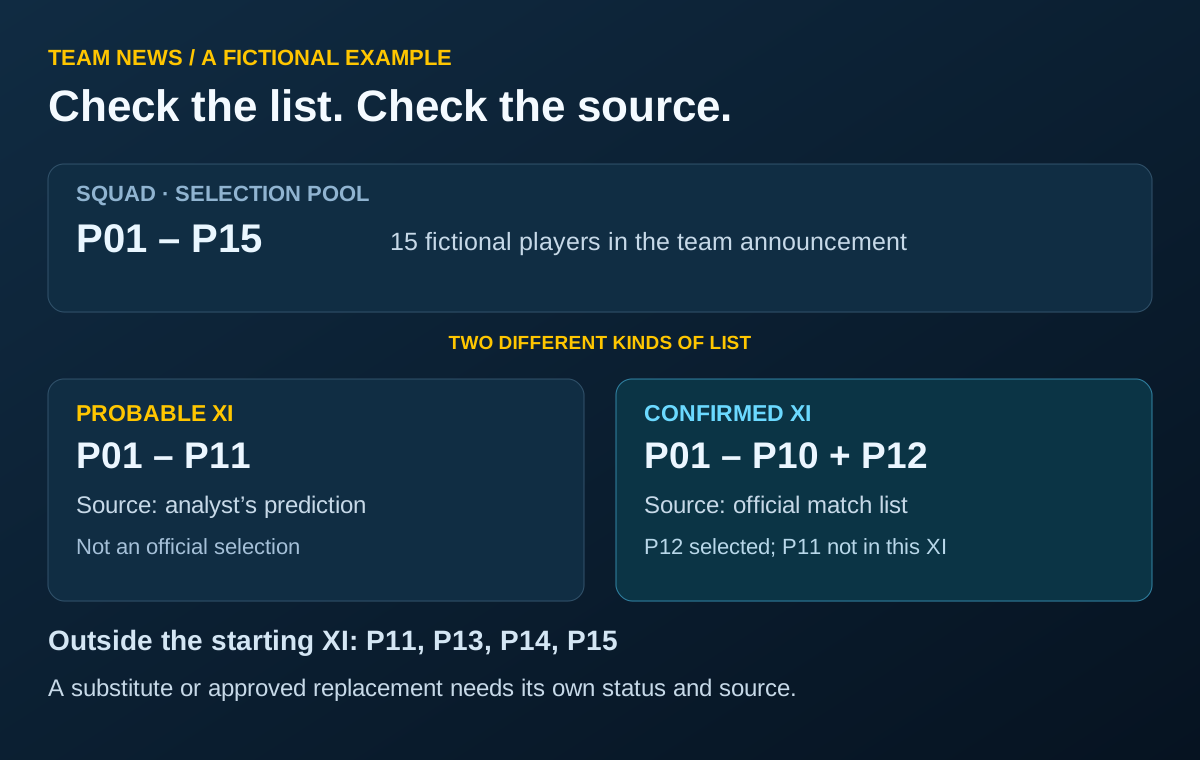
Think of a squad as a pool, with a predicted XI as one proposed selection from it. The official XI is a separate decision supported by the relevant announcement. Prediction is optional: teams do not have to pass through an analyst’s list before naming their players.
In our exercise, P11 is predicted to play, but P12 appears in the official XI. The correct update is “P12 selected; P11 omitted from the starting XI.” It would be an unsupported leap to write “P11 is injured” without a separate source. An omission tells you about selection, not automatically about its cause.
A worked team-news update
Imagine a fictional Blue side preparing for one fixture. The times below are invented local times for that fixture, not a live match schedule.
- 09:00 — squad available. The team announcement lists P01–P15. Save the source and label the record “Squad”. There is no confirmed match XI yet.
- 13:00 — preview published. An analyst selects P01–P11 and explains the assumptions. Label this “Probable XI”. Keep it separate from the team’s announcement.
- 13:30 — official match list available. The source names P01–P10 plus P12. Mark those eleven as confirmed for this fixture. P11, P13, P14 and P15 are outside this starting XI; do not invent substitute roles for them.
- After confirmation — retain the change. Add the source and check time. If another authorised change is reported, record that change explicitly instead of silently rewriting the earlier status.
This workflow produces an auditable note: “Checked at 13:30: P12 replaces P11 in our earlier prediction; source is the official match list.” It does not imply that P11 was officially selected and then formally replaced.
A substitute fielder is not the same as a replacement
For the ICC men’s T20I conditions dated October 2026, captains nominate eleven players and up to four substitute fielders before the toss. Under clauses 24–25, an ordinary substitute fielder cannot bowl or captain; wicketkeeping needs umpire consent, and only a nominated player may bat. This is a specific ruleset, not a statement covering every competition.
A concussion replacement is a different mechanism under clause 1.2.7, with a formal request and match-referee approval. Read an official replacement notice before changing a player’s status. A photo of a reserve fielding is not enough to establish that a full replacement has been approved.
How to check a “confirmed” claim
- Match the fixture. Check teams, date, competition and match number. A correct list from the previous game is still the wrong list for today’s game.
- Find the primary announcement. Prefer the competition’s match centre or the team or board’s named XI. Use the announcement itself, not just a search snippet or a reposted graphic.
- Record time and status together. “Checked at 13:30, official XI” communicates more than “latest team news”. Include the timezone when sharing a real update.
- Resolve conflicting versions. Compare timestamps and corrections. If the primary announcement cannot be located, leave the XI unconfirmed instead of upgrading a prediction.
For a series page, keep the wider squad reference and each match’s XI in separate places. The India–New Zealand series archive is a navigation example; use the relevant fixture’s own dated sources when reviewing any past match.
What does this mean for fantasy selection?
Your fantasy team is a platform selection, often drawn from both sides. It is not the same object as either real team’s XI. Start by checking the real-world player’s status, then consult the platform’s eligibility, lock time, substitution treatment and scoring rules.
Confirmation does not promise a particular batting position, number of overs or points total. A substitute label does not by itself establish how a platform awards points. Avoid turning these unknowns into guaranteed opportunities.
Use the IPL team-selection checklist to organise the checks, or work through our fictional fantasy team to practise credits and roles. After play begins, the scorecard guide explains what the recorded performance fields actually mean.
Check your understanding
A player appears in a 15-person squad. Are they confirmed to start?
No. In this example the squad is the wider selection pool. You still need the official match XI.
Three previews list the same eleven. Is that confirmation?
No. Agreement between predictions is still agreement between predictions. Look for the primary match announcement.
P12 appears instead of predicted P11. Was P11 formally replaced?
Not on that evidence. Our prediction changed when the official XI became available. A formal replacement is a separate event requiring its own source.
About this guide. Written by the comeplaygo.com Editorial Team. Examples and diagrams are original teaching materials; figures are not match predictions. Reviewed 2 November 2026.
Rules checked 2 November 2026: ICC Men’s T20I Playing Conditions, October 2026, clauses 1.2, 24 and 25; the linked IPL regulation announcement covers its own competition. Example timeline and diagram are original.