Calculate runs conceded per over
Use the bowler’s runs conceded and overs from the same record. This tool uses six valid balls per over. Choose cricket overs notation or enter the number of legal balls directly.
Your calculation will appear here.
Why 4.3 overs means 27 balls
The dot separates complete overs from the balls in an unfinished over. It is not a decimal point. In a six-ball system, 4.3 = (4 × 6) + 3 = 27 legal balls. Those 27 balls are equivalent to 4.5 complete six-ball units for division.
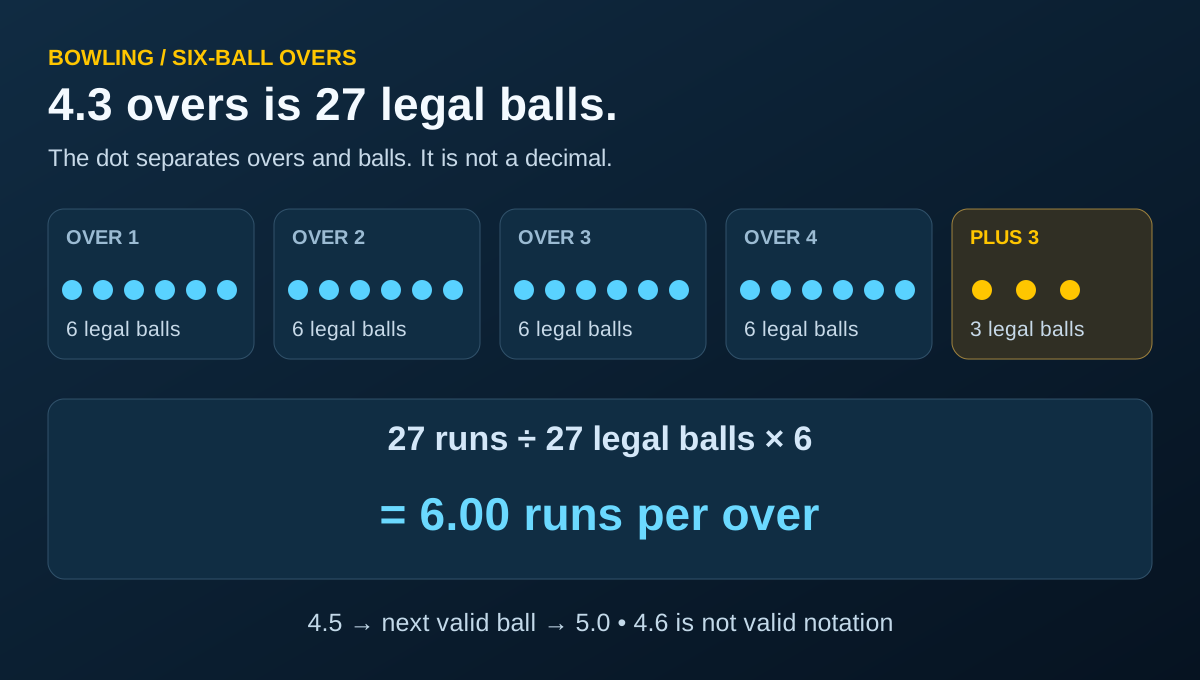
After 4.5, the next valid delivery completes the fifth over, so the notation becomes 5.0. Entering 4.6 here produces an error. Do not turn 4.3 into 43 balls or divide 27 by the decimal number 4.3.
MCC Law 17 defines the six-valid-ball over; wides and no-balls do not count toward those six. Other exclusions can apply, so use the recorded valid-ball count rather than counting every physical delivery. Formats using different ball groupings are outside this tool’s scope.
The economy-rate formula
For 27 runs from 27 legal balls, the bowler has conceded one run per ball. Multiplying by six gives 6.00 runs per over. The equivalent calculation is 27 ÷ 4.5; converting cricket notation must come first.
| Runs | Overs | Legal balls | Economy |
|---|---|---|---|
| 27 | 4.3 | 27 | 6.00 |
| 24 | 4.0 | 24 | 6.00 |
| 25 | 3.5 | 23 | 6.52 |
| 0 | 1.0 | 6 | 0.00 |
| 1 | 0.1 | 1 | 6.00 |
In the third example, 25 ÷ 23 × 6 = 6.521739… . The displayed answer is rounded to two decimal places after the full calculation. A zero-run spell is valid if at least one legal ball has been bowled.
Which runs count against the bowler?
Use the bowling table’s R value. Under MCC Law 18.10.3, the bowler is charged with batter runs, no-ball extras and wides. Byes and leg-byes contribute to the team total but are not charged to the bowler. Do not add every extra to the bowling figure.
For an illustrative completed over containing 5 batter runs, 1 wide and 2 leg-byes, the team gains 8 runs while the bowler concedes 6. If it contains six valid balls, the economy for that over is 6.00. Using 8 in the input would answer a different question.
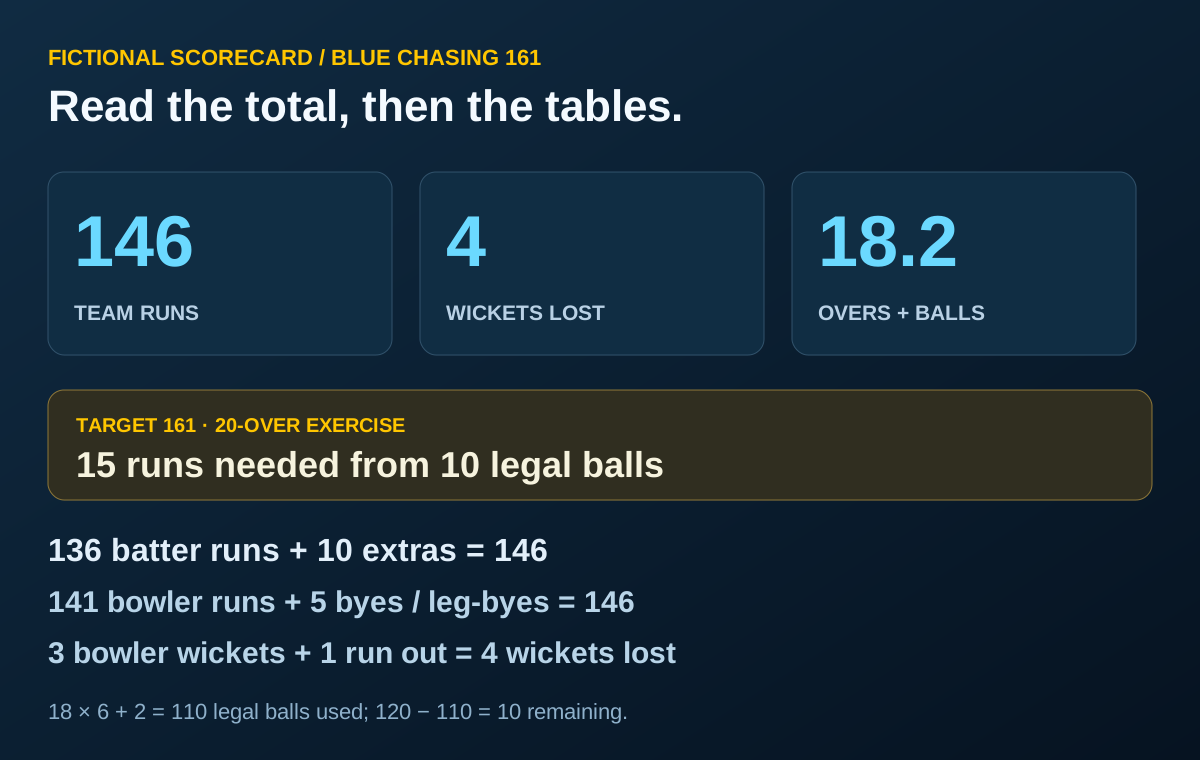
The worked scorecard puts this distinction into a full example: 146 team runs, 141 charged to bowlers and 5 byes or leg-byes. For unusual penalty events, take the official bowling analysis as the starting point.
Combining spells or matches
Add the runs conceded and legal balls before calculating. Do not take a simple average of economy rates. Suppose one record is 6 runs from 1 over and another is 36 from 4 overs. The combined record is 42 from 5 overs, giving 8.40. Averaging the separate rates of 6.00 and 9.00 would give 7.50 and ignore the different workloads.
Cricket overs also need ball-based addition: 2.4 plus 1.4 is 16 + 10 = 26 balls, written 4.2 overs. It is not 3.8 overs. Enter 26 in legal-ball mode to avoid carrying errors.
Economy is one statistic, not a verdict
A rate alone does not describe the match phase, surface, opposition or wickets taken. Compare like-for-like records and inspect the workload: 6.00 from one ball is based on far less evidence than 6.00 from a longer spell. This calculator does not assign universal “good” or “bad” bands.
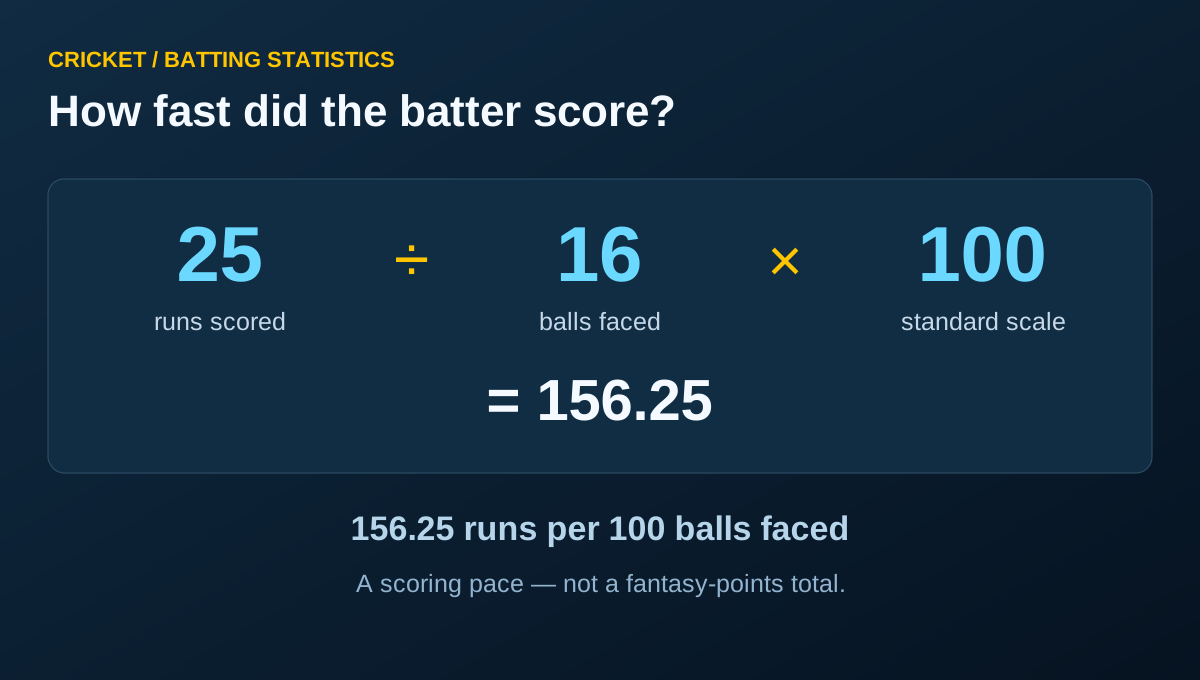
Economy is different from batting strike rate, which measures runs per 100 balls faced. It also differs from bowling strike rate, balls per wicket, and bowling average, runs per wicket. Use the statistic matching the question you want to answer.
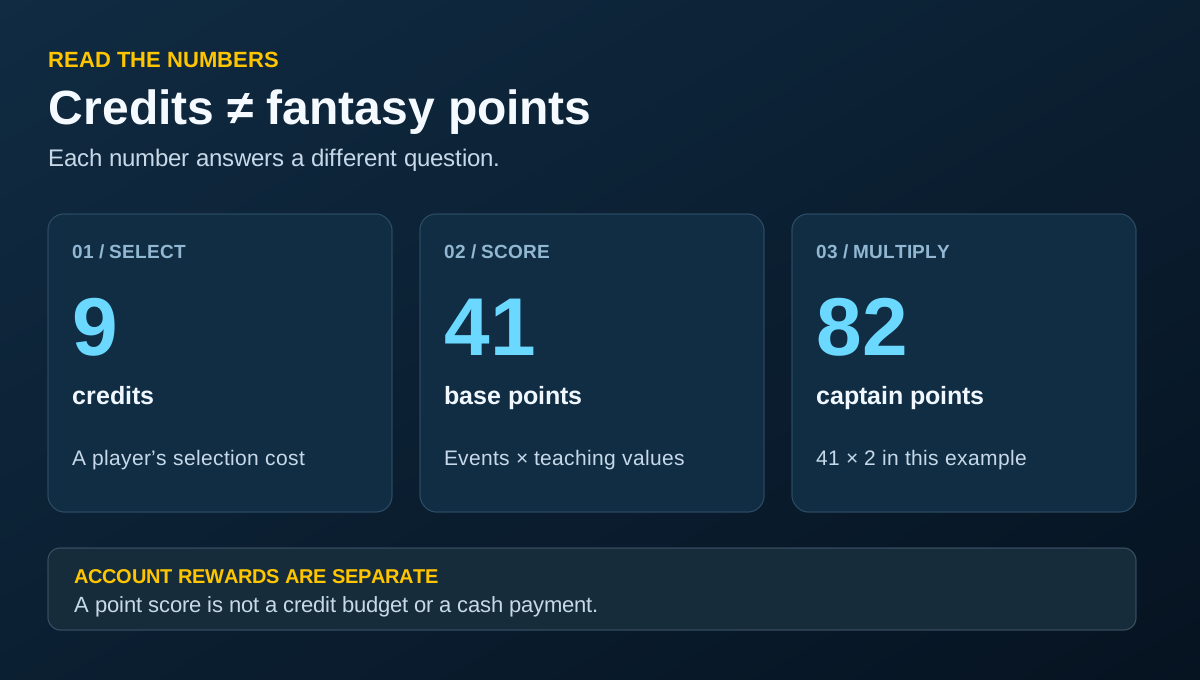
A fantasy scoring adjustment is a separate calculation. Check the platform’s format, minimum overs, thresholds and rounding policy before translating an economy figure into points. Our fantasy scoring guide explains this boundary.
Calculator questions
Why is 0.0 overs rejected even when runs were conceded?
Wides or no-balls can add runs before a valid ball is recorded. With zero legal balls, this formula has a zero denominator, so it cannot produce a defined economy rate.
Can I enter 4.50 as 4 overs and 5 balls?
Enter 4.5. This tool accepts one optional digit after the dot, from 0 to 5, to keep cricket notation unambiguous.
Does switching input modes convert my entry?
Switching modes clears the delivery field to avoid treating an over entry as a ball count. Runs conceded stays in place. The result always shows both overs and legal balls.
About this guide. Written by the comeplaygo.com Editorial Team. Examples and diagrams are original teaching materials; figures are not match predictions. Reviewed 2 November 2026.
Rules checked 2 November 2026: MCC Laws, 2017 Code, 4th edition (2026), Laws 17, 18.10.3 and 38.6. Field layout reference: Japan Cricket Association score sheet. Maiden terminology: JCA-hosted scoring guide (July 2008); its old no-ball allocation table is not used. All numerical examples and diagrams are original.